If you’ve spent any time researching personal finance, you’ve probably heard the same advice repeated again and again:
“Just invest in index funds. Buy the S&P 500. Hold it for 30 years. You’ll be fine.”
And honestly… that advice isn’t wrong.
Index fund investing is one of the simplest, most effective wealth-building strategies available to Canadians. Over long periods of time, broad-market index funds have historically delivered strong returns. They’re diversified, low cost, and require almost no effort to manage.
But there’s a problem.
Not a math problem.
A human problem.
Because while index fund investing works beautifully in theory, the real question is:
Can you actually stick with it?
That’s what we want to unpack here—because financial freedom isn’t just about picking the “best” investment strategy. It’s about choosing a strategy you can follow consistently through the inevitable ups and downs of real life.
Before we go further, it’s worth clarifying what we mean when we say index fund investing.
There are many different types of index funds—some track specific sectors, some track bonds, and others focus on dividends or niche markets.
But in this post, when we refer to index fund investing, we’re talking about the classic “buy the market” approach popularized by personal finance authors like J.L. Collins (The Simple Path to Wealth) and Ramit Sethi (I Will Teach You To Be Rich).
This style of index fund investing usually means investing consistently in broad-market funds such as:
- an S&P 500 index fund (like VFV or VOO)
- a total market index fund
- or a globally diversified Vanguard-style index fund
The philosophy is simple: rather than trying to pick winning stocks or time the market, you invest in a diversified basket of companies, contribute regularly, and allow long-term compounding to do the heavy lifting.
So throughout this article, when we say “index funds,” we’re referring specifically to this total market indexing strategy—not niche or specialized index products.
The Promise of Index Fund Investing
The appeal of index fund investing is simple:
- Buy a low-cost index fund (like an S&P 500 ETF)
- Contribute regularly
- Stay invested through market cycles
- Let compounding do the heavy lifting
Many popular personal finance voices advocate this strategy because it removes complexity. You don’t need to stock pick. You don’t need to time the market. You don’t need to obsess over charts.
It’s a “set it and forget it” approach.
But here’s the truth:
Index fund investing is only “set it and forget it” if you can ignore volatility.
And most people can’t.
The Real Risk Isn’t the Market… It’s Your Behavior
The biggest risk in investing is not a bad year in the market.
It’s what you do when that bad year arrives.
Because when your portfolio drops 20% or 30%, the math might tell you:
“Keep investing. This is normal.”
But your brain tells you:
“Get out before it gets worse.”
This is why so many people fail with otherwise “good” investment strategies. They don’t fail because index funds are flawed.
They fail because they abandon the strategy at the worst possible time.
That’s why when we talk about building wealth, we keep coming back to one key idea:
Long-term success comes from habit strength, not strategy perfection.
Index Fund Investing as a Growth Strategy
Index fund investing is primarily a growth strategy.
You invest money today with the expectation that the asset will be worth significantly more in the future.
Your return comes from:
- capital appreciation (the fund grows in value)
- small dividends along the way
But most of the growth is expected to come from price appreciation.
That’s fine when you’re accumulating wealth.
But it raises a question when you’re approaching retirement or financial freedom:
What happens when you need income?
The 4 Percent Rule in Canada: A Useful Starting Point… With Big Limitations
A lot of retirement planning revolves around the famous 4 percent rule.
The idea is simple:
If you withdraw 4% of your portfolio each year, your money should last long enough to support retirement.
But here’s what many people don’t realize:
The 4 percent rule assumes you can keep withdrawing even during down markets.
And that’s where things get tricky.
Because if markets fall early in retirement (known as sequence of returns risk), you may be withdrawing money while your portfolio is shrinking.
That creates a double hit:
- your investments decline
- you sell shares to fund lifestyle spending
That’s one of the biggest dangers retirees face.
So the question becomes:
Is index fund investing alone enough to create stable income for retirement?
Or does it require another layer?
Why Real Estate Feels Different (Index Fund vs Real Estate)
This is where the comparison of index fund vs real estate becomes important.
Because many Canadians—especially business owners and high-income professionals—feel far more confident investing in real estate than investing heavily in the stock market.
And it’s not because real estate is always better.
It’s because real estate has psychological advantages that make it easier to stick with.
Let’s unpack why.
1. Real Estate Feels Tangible
When you buy a rental property, you feel like you own something real.
You can see it.
You can touch it.
You can improve it.
You can renovate it.
You can drive by it.
Even if the market dips, there’s still a physical asset sitting there.
With index funds, your money feels abstract. It exists on a screen. And when the market drops, it can feel like your wealth is evaporating into thin air.
2. Real Estate Produces Visible Cash Flow
Even if the property value fluctuates, rental income keeps showing up.
That monthly rent payment is psychologically powerful because it provides confirmation that the investment is “working.”
Even if you’re cash flow negative for a short period due to repairs or vacancies, you still see money coming in.
Index fund investing doesn’t feel like that.
Unless you’re specifically investing for dividends, most people don’t see meaningful income coming from their index funds. The strategy relies on growth.
And growth doesn’t feel real until you sell.
3. Real Estate Volatility Is Hidden
Here’s a sneaky one.
Real estate is volatile too.
But you don’t see the price of your rental property changing every single day.
Your rental property isn’t re-priced every morning on your phone.
With index funds, you can check the value every minute. That constant feedback loop creates anxiety and emotional decision-making.
Why Canadians Avoid Leveraged Investing (Even When the Math Works)
Now let’s talk about the elephant in the room:
Leveraged investing Canada strategies.
Most Canadians already use leverage… they just don’t call it that.
A mortgage is leverage.
But here’s what’s interesting:
Canadians are willing to borrow to buy real estate, but hesitant to borrow to invest in the market.
Even though the stock market has a strong historical track record.
Why?
Because again… it’s not a math problem.
It’s a psychology problem.
Borrowing to invest feels risky because if the market drops, you feel like you made a terrible decision.
You might even feel trapped.
And the bigger the loan, the bigger the emotional pressure.
That’s why leveraged investing strategies often fail—not because the numbers don’t work, but because investors can’t stay consistent when things get uncomfortable.
The Missing Piece: Income Investing Strategy
This is where many investors start shifting their thinking.
Instead of focusing only on growth…
They begin focusing on income.
Because income is what gives people confidence.
Income is what creates stability.
Income is what helps you stay invested during downturns.
That’s why an income investing strategy can be a powerful complement to index fund investing.
Instead of investing in assets that rely on appreciation, income-focused investments aim to generate consistent distributions—monthly or quarterly.
And that can be a game changer for behavior.
Because if you can see income arriving regularly, it becomes easier to stay the course.
Growth vs Income: What’s the Real Difference?
Here’s the simplest way to think about it:
Growth investing says:
“My investments will grow over time, and I’ll sell later.”
Income investing says:
“My investments will pay me now, and I’ll reinvest or spend the cash flow.”
Both can build wealth.
But psychologically, income investing feels more like real estate. It gives that “rent cheque effect.”
That’s why many investors who struggle with index fund volatility begin looking for income-producing assets like:
- dividend-paying funds
- private credit funds
- mortgage investment corporations (MICs)
- structured income portfolios
The goal isn’t to chase yield blindly.
The goal is to build a system that supports habit formation.
A Smarter Way to Use Leverage: Borrowing for Income
If you’re considering borrowing to invest, one approach that feels safer for many people is borrowing for income-producing investments, rather than borrowing for pure growth.
Why?
Because you can visibly see the arbitrage.
For example:
- borrowing at 6%
- earning 9% income
- the spread becomes profit
When the income hits your account each month, you feel confident the strategy is working.
It reduces the urge to panic when markets fluctuate.
This doesn’t eliminate risk, but it often aligns better with human psychology.
Why Index Fund Investing Alone Isn’t Always Enough
Index fund investing is excellent.
But the mistake many Canadians make is thinking:
“If index funds are the best investment, then I should put everything there.”
But most people don’t actually do that.
They might say they’re “100% equities”…
But then they hold:
- large cash reserves
- fully paid off homes
- corporate retained earnings sitting idle
- money waiting on the sidelines
So the real issue isn’t usually the investment strategy.
It’s that a lot of capital stays underutilized because investors don’t feel emotionally safe deploying it.
That’s where planning becomes more important than picking the “best fund.”
Designing a Portfolio You Can Stick With
If you want a portfolio that actually gets you to financial freedom, you need to design it around two things:
1. What works mathematically
and…
2. What works emotionally
Because the best portfolio in the world is useless if you abandon it.
A sustainable portfolio often includes a blend of:
- growth assets (like index funds)
- income-producing assets (cash flow)
- liquid “dry powder” reserves for opportunity and safety
- diversification across asset classes
This is exactly why many high-net-worth Canadians and business owners build portfolios that include:
- real estate
- index funds
- corporate investments
- income strategies
- permanent insurance as a liquidity reservoir
Not because they’re trying to be fancy…
But because they’re trying to build a strategy they can stick with for 30 years.
The Big Lesson: The Habit Is the Strategy
At the end of the day, the question isn’t:
“Should I invest in index funds or real estate?”
The question is:
“What strategy will I still follow when markets drop and fear takes over?”
Index fund investing is an incredible tool for wealth building.
But it works best when it’s paired with a portfolio design that supports consistent behavior—especially as your income needs change and retirement approaches.
Because financial freedom isn’t built by the highest-return portfolio.
It’s built by the portfolio you actually stick with.
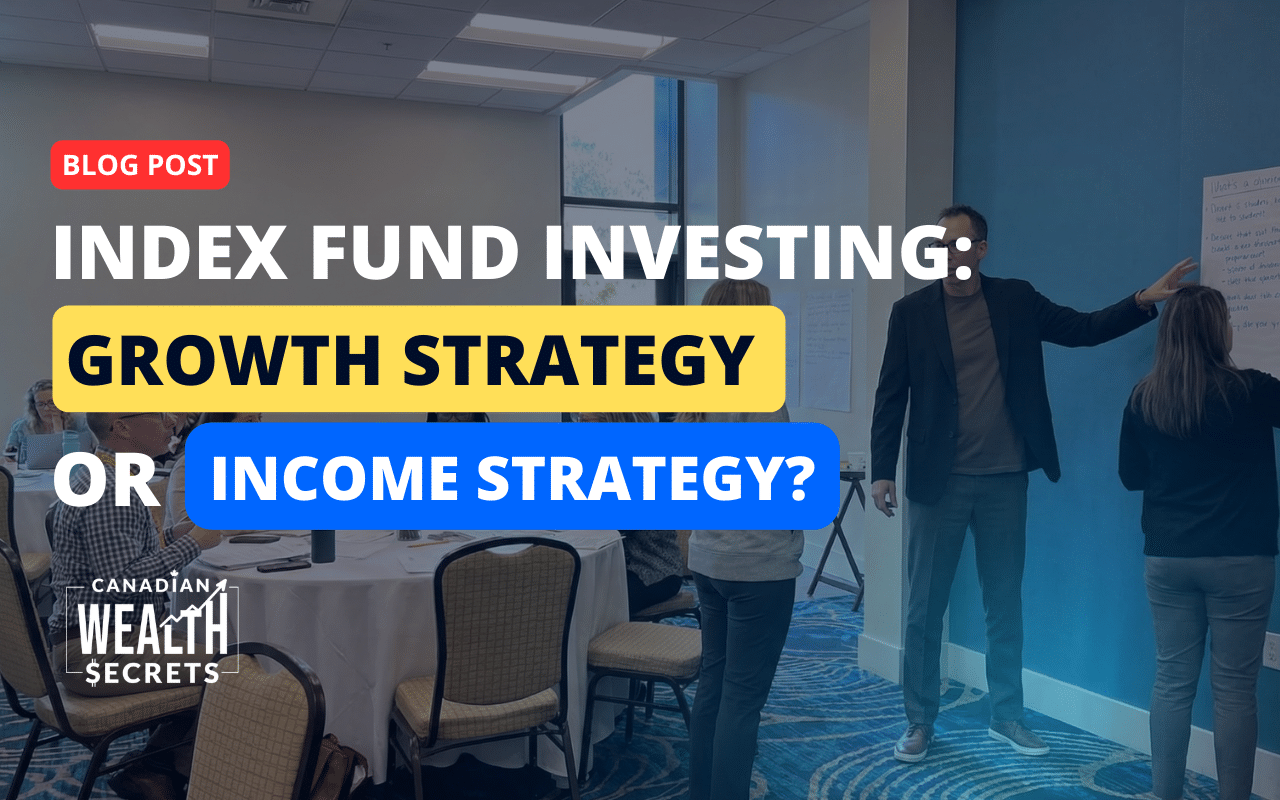
Final Thoughts: Index Fund Investing as Growth or Income?
So, is index fund investing a growth strategy or an income strategy?
For most people, it starts as a growth strategy.
But as you approach financial freedom, the income conversation becomes unavoidable.
That’s why the best approach for many Canadians isn’t choosing one side.
It’s building a portfolio that balances growth, income, leverage, and psychology—so you can invest consistently through every market cycle.
Want Help Designing a Portfolio That Fits Your Life?
If you’re a Canadian business owner, investor, or high-income earner and you’re trying to decide:
- how much to allocate to index funds
- whether to use leverage
- how to generate retirement income
- how to reduce emotional investing mistakes
…then it might be time to step back and design a full wealth strategy.
At Canadian Wealth Secrets, we help clients build sustainable financial plans that align with long-term wealth building and real-life behavior—so you can create a strategy you’ll actually stick with.
Visit CanadianWealthSecrets.com/discovery to explore your next steps.