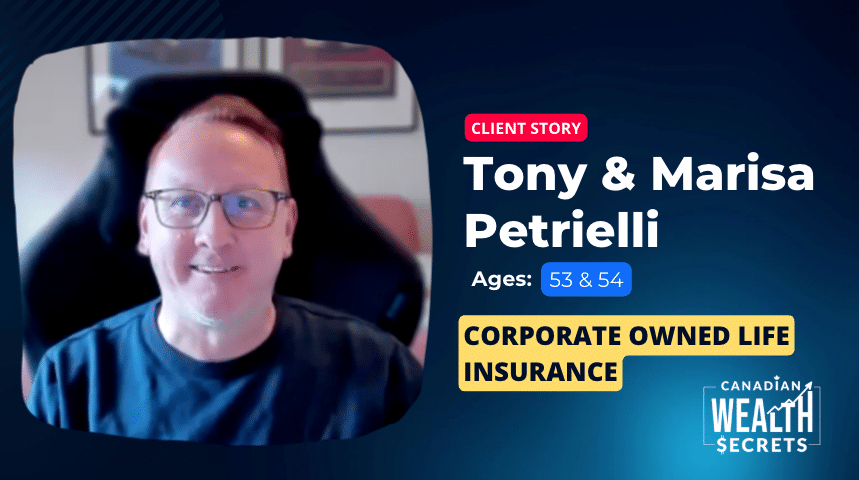
Client Story
How a Clear Financial Plan Changed Everything for This Canadian Family’s Future
The Problem
Tony Petrielli had it all—or so it seemed.
With a thriving career, a paid-off mortgage, a well-run business, and robust savings, Tony and his wife Marisa were living the dream many aspire to.
But behind the scenes, Tony felt something wasn’t quite right.
Their financial life felt scattered—investments, RRSPs, corporate savings—everything was there but not working together.
He knew he wanted more than just “managing money.” He wanted a strategy.
A clear, actionable plan that didn’t just secure their retirement but created a lasting legacy for their two daughters.
Listen here on our website
“It felt like we were throwing darts blindfolded, hoping we’d hit the target. My wife and I wanted more than that. We wanted a plan—a real plan that didn’t just make sense today but secured a legacy for our daughters.”
The Solution
He wanted a plan that just made sense. That’s when Tony connected with our lead financial planner Kyle.
Kyle’s approach wasn’t about cookie-cutter advice or overwhelming jargon.
Instead, he started by truly listening to Tony’s goals and concerns.
He broke complex financial strategies into simple, actionable insights and even created personalized videos for Tony to share with Marisa. These videos helped bridge the gap and make decision-making easier for both of them.
Bit by bit, Tony and Kyle worked through everything: from tax efficiency and leveraging corporate savings to mapping out a plan for long-term wealth and legacy building.
What had once felt scattered now had clarity.
“At first, I was skeptical. But then he started doing something no one else had done: he listened. I mean, really listened. He took my jumble of questions—about RRSPs, corporate savings, even whether we should keep using a HELOC—and turned them into straightforward insights.”
The Outcome
With each conversation, Tony felt less like he was playing financial catch-up and more like he was building something meaningful—for today, tomorrow, and the future.
Tony’s biggest lesson was this: True wealth isn’t just about having money; it’s about having clarity.
When your financial plan aligns with your goals, you stop guessing and start moving forward with confidence.
“It’s not about fancy jargon or overwhelming spreadsheets. It’s about creating a plan that makes sense for you—your family, your goals, your future.“
The Insight
Like Tony, many families feel stuck—not because they don’t have enough income or assets but because their financial strategy feels disconnected.
Without clarity, it’s easy to lose momentum or feel like you’re one bad decision away from chaos.
For Tony, it wasn’t about reinventing the wheel; it was about making smarter decisions with what he already had.
If Tony’s story feels familiar, you’re not alone. Many high-earning families struggle to turn good finances into great legacies.
The key is having the right guide.
Discover how Kyle helps families like Tony’s create clarity, confidence, and lasting wealth.
Reach out to us here to see if our strategies and guidance are the right fit for you and your business.
Don’t let taxes eat away at what you’ve worked hard to build.
Book a call with us to learn how to leverage your corporate earnings effectively and set your wealth up for long-term growth.
Want to save a significant amount of income tax each year while increasing your tax sheltered net worth?
While Canadian incorporated business owners spend thousands of hours each year owning and operating their profitable businesses, the vast majority spend no time focusing on what really matters: tax planning.
Instead of spending all of your time and energy to make an additional $100,000 of net operating income only to see almost half of it lost in taxes by the time it hits your personal pocket, you should be spending more time tax planning so you can keep more of the money you’re already losing to income taxes.
Our efficient, unique and compliant corporate wealth management and Canadian tax planning structures allow incorporated business owners to minimize their income tax burden, keep more capital for asset accumulation and incorporate an estate plan that creates a legacy that lasts generations for your family.
Detailed Episode Summary
Luck, Volume, and Planning for Success
Jon and Kyle discussed the role of luck in business success and how to increase opportunities for success through volume. They believed that luck is not negated by volume but instead increases with each opportunity, much like rolling a dice repeatedly. They also stressed the importance of preparation, hard work, and planning in defining luck and achieving success. They encouraged individuals to take control of their wealth building journey by creating their own volume and investing time in clear planning. Lastly, Kyle mentioned the release of the fourth weekly episode of ‘Secret Sauce’ and asked for feedback on the initiative.
Transcript From Case Study Video:
All right there, Canadian Wealth Secret Seekers. It’s Kyle here again for another Friday Secret Sauce episode. And today I’m excited to share another case study with one of our clients here at Canadian Wealth Secrets. This particular individual is a Canadian entrepreneur, is incorporated, but may have some similarities to your situation, whether you’re incorporated or not. And I’d like to share the strategy that we have sort of co-created
together. So first off, before we dig in, I just want to give you a sense of what you’re going to get out of this episode. Really what we’re going to look at is how we can be cautious and careful to plan for tax minimization, both in the short term, the medium term, and of course the longer term as well without hindering or interrupting your big wealth growth.
strategies, your goals, your ambitions, whatever it is that you might be after. A lot of people look at this as an either or, and I like to try to find the best ways that we can have our cake and eat it too. Now, sometimes that means a little bit of, you know, a give and take in order for this to happen, but ultimately at the big picture, when we look at it, we wanna see, we net better? Some of the things that we’re looking for, and we did this with this particular client I’m about to share,
is we looked at their entire situation. We looked at their personality, what they had done so far, and tried to match that up with what they could do to try to maximize not only their net worth, but also the amount of spendable income they’ll have both now and in the future, as well as how they can plan properly for their estate. I’ve said it so many times before.
When we’re younger in our younger years, I know I’m gray, I’m losing my hair, I’ve got a gray beard typically. And at the end of the day, you know, it doesn’t seem like I’m all that young, but I’m still in the planning mode of like, what does it look like for me in my later life, right? And that’s probably where a lot of you Canadian wealth secret seekers are as well. But the reality is, is that with each passing year that goes by, and as we get more and more comfortable with the goals we’ve set for ourselves and how we’ve achieved those goals from a financial perspective, we start to think about others. We start to think about our family, our legacy and all of those details. So being able to have plans that not only help you grow so that you can have the lifestyle you’re looking for when you hit that financial freedom number or those years that you’re after, but also to be able to prepare for your estate is what we specialize in doing here.
So I’d like to introduce you to this specific client. This client has been in business for over 20 years, but only for the last handful of these years have they been scaling. more recently, have essentially 3x their profitability. So congrats to this particular client. They’re in their early 50s, and they actually take a relatively conservative salary right now. Now, this person is the business owner.
They also have a spouse who has a T4 job with a pension, which is really nice. That’s a great little mix. And for these individuals, that gives them a little bit of extra safety net. Now, this particular individual, this client is taking only around $100,000 per year. Why? Because they don’t want to be paying more than that on their personal taxes. As you know, here in Ontario anyway, where this client is from, after about $94,000, we start entering into a new
new tax bracket and we start moving up from there. So taking somewhere around 100,000 is kind of a nice, you know, sort of I’ll say middle ground there. You’re not net, you know, you’re not net zero on the amount you’re taking out from your corporation compared to the small business tax credit. But it is not, you know, absurd. It’s not an absurd amount. So it’s a nice number that they’re taking out. However, they feel though, like
They’re a little bit tight on the outside, quote unquote. They’re doing fine. They’re living a nice, comfortable lifestyle. But there’s a little bit of worry that they have retained earnings inside this corporate structure. And they’re in their mind sort of picturing, like, when am I ever going to be able to utilize this at a personal level? The only real thought they might have is, if we just keep it growing inside of there, we can just slowly continue taking out $100,000 for the rest of our lives, which is definitely a possibility.
They’re looking for something a little bit more efficient, a little more optimized. Right now, they have about $700,000 in retained earnings inside the corporate structure. And they anticipate another $500,000 or so in retained earnings each year moving forward for at least the next five to 10 years while they continue running and operating this business. So that’s a great position. It’s great problem to have, we like to say. On the outside, they’ve got a home worth over half a million dollars.
And there’s only about, I would say, a third of the home owing in their mortgage. So a small mortgage. They’re OK with it, but obviously, it’s still cutting into a little bit of that cash flow. would be nice if they could do something about that. They have a typical car loan. And they even mentioned this idea of maybe considering when they’ve been listening to our episodes, that’s how this client found us, they’d been listening and were intrigued by the Smith maneuver.
didn’t necessarily feel super comfortable with this idea of borrowing against their primary residence. However, they’re still open to it, and this is something we’re going to continue to explore together once the first part of this plan is set in place. And you’re going to hear about the first part of this plan. So the idea of debt is something that they’re sort of, I’ll say, on the fence about, specifically against the primary home. However,
They are open to trying to learn more and trying to see how they can do this a little bit better. Let’s talk a little bit more about personal assets. So they’ve got, I would say about a quarter million dollars in RSPs for the one business owner. The spouse, as I mentioned, has a T4 job with a pension. So again, nice safety net there. Pension is basically an annuity. You’re paying into it. Usually there’s a match and you know exactly what it is you’re gonna get. Essentially it’s an insurance policy.
and insurance companies provide this thing called an annuity, same idea that’s going on there. So that’s a nice safety net to have there as well. Now, they did stop funding the RSP because they recognized a number of years ago that it was like they would take more money out of the corporation, out of one jail, pull it out, get taxed on it, put it into the RSP in order to get that tax money back, right? So essentially they were taking it from one jail and putting it in another.
Now, depending on what you’re investing in, it still makes sense to do some of that to the RRSP. However, the plan for today we’re going to look at is a little bit more nuanced for this particular business owner. Now, that $700,000 I had asked, what is it doing right now inside the corporate structure? Is it invested in real estate? Is it invested in equity funds? Is it invested in interest bearing income or passive income?
which is going to be taxed unfavorably. And I found out that it is currently sitting in a GIC. And as you’d know from last Friday’s episode, that money sitting in the corporation earning interest, earning passive income, is taxed very heavily. Here in Ontario, it’s over 50 % that you’re going to lose of the upside. In other provinces, the lowest province being Alberta currently is around 46%. It’s a massive amount that you are losing to the government every year.
Now, my big question was why in a GIC and not something else? Was it that they were risk adverse? And the response I got wasn’t necessarily that it was because they’re risk adverse, but rather because they have a plan in these next five to 10 years. And the plan involved buying the building that they were currently leasing to run and operate their business.
all of a sudden the light bulbs went off for me and we got into strategy mode. And this is exactly what we do for all of our clients is try to get as big a picture as wide a picture as we possibly can in order to try to put the puzzle pieces together with something that’s going to make more sense for them. So whether it’s risk that they were avoiding the markets or not is is still, you know, something we’re working through. However,
I would argue that there was probably a little bit of that risk, a little bit of that fear. But then the greater part is that we know that putting money into the market can be volatile, meaning if they need that money and they want to buy this building in the next five to 10 years, you know, you could do well for the first few years. But if we hit a big market downturn, that could be problematic. Right. So ultimately, that made sense to me. They’re making some money on this money while they waited.
And that’s better than doing nothing, right? So I usually say it’s like putting money under the corporate mattress. Some people do this with GICs or just savings accounts while they’re just kind of navigating business because they don’t know if they’re gonna hit a down year at some point and they might need access to this capital. They certainly don’t wanna be running into a market correction of some point when they need those funds. So makes perfect sense. So with that in mind,
we got to planning and we got to strategizing how we would purchase this building. Now since then, the building, the agreement that they’ve made is that why they’re going to purchase it in a number of years is due to some of the municipal restrictions and sort of the tie-ups, but also there’s really something going on with severing the property. They’re not able to sever the property for several years. So.
we’re working together to try to structure a seller financed or a vendor take back deal where basically they’re agreeing on a price point now, which is great. And they’re going to make that purchase in the future. And in the meantime, the lease payments are going to go towards purchasing or the cost of this building. So it’s like you’re paying a mortgage, but you don’t hold title yet. You essentially have the option to buy at a lesser price.
in 578, whatever, however many years away it will take until they’re legally allowed to sever this property. So I’m loving the direction of the creative financing on the real estate deal and where that’s going. We’re going to continue to work together on that. I’m going to support this client in doing so to make sure they’re comfortable. I love real estate, so I love it. We’ve gone through some numbers. The price point looks pretty good. It’s inflated a little bit, but that also includes the idea that
you know, there’s going to be several years of appreciation ahead. So I’m liking where it stands currently. But here’s what we’re going to be doing. And this client is moving forward with it. They actually had their approval come through just a week or so ago. And they are currently going to be changing some of the funding from the GIC and moving it over to a policy.
Now, some of you might know that, hey, listen, we want to try to get as much money into this policy to cut down on passive income tax as we possibly can, especially in a case like this, where there’s a bit of a runway. We know we need to wait before we can purchase this property, and we want to keep liquidity at the same time. Same idea as a GIC, without the passive income taxes. So when I bring this up on the screen for those on YouTube with me,
You’ll be able to check this out. you’re not, you can check it out later and and I will do my best to try to help you follow along. You’ll see this spreadsheet here. I just want to run down the situation. We know that typical policies, okay over and I say typical. That’s actually the wrong way to describe this policies that we design to have an early high cash value are designed such that we can see growth in the four ish.
percent range on average over the life of this policy. Okay. There’s that first couple of years of opportunity costs, which we’ve addressed before, but even when we include those years in our calculation, the average rate of return is around that four ish percent. So we’re going to use that number here. We’re going to compare it to the four ish percent GICs that the $700,000 is sitting in right now. And you’ll notice that within one year,
of sitting inside a GIC versus say the policy, there’s going to be a $14,000 difference in the upside of picking the policy over the GICs. Okay, now, you know, the GIC is going to let you walk away with $14,000 after passive income tax, whereas the policy will have grown around $28,000. And again, we’re looking at this over an average period of time, because again, year one, we’re not going to be able to leverage out
all of that money yet. There’s a little bit of a restriction there. All right. As we explore them, we’re going to use a 10 year runway here for this for funding this policy. We’re going to assume the purchases made in year 10. Okay. It could happen early. It could happen in year nine or eight or seven, but we’re going to use your 10 for this particular example. And just to drive home the point. So if we just compare the GIC growth of the 700,000
to $700,000 sitting in a policy without adding any new income to this situation or any new funding to either the GIC bucket or the policy bucket, you’re gonna notice by year 10 that the GIC value with the compounded interest being rolled back into GICs at 4%, which again, we don’t know if that’s gonna hang on for how long that’s gonna be, right? GIC values are going down currently anyway with rates falling.
they’ll end up with 836,000 and change. Whereas the policy’s cash value would approximate to be around 996,000. That’s $860,000 difference if we round to the nearest thousand. So $160,000 difference. That’s just in the policy growth comparing the two tools, okay? Remember, the cash value, we can leverage against this cash value at any point in the journey.
straight from the insurer up to 90 % of the cash value, or we can go to a big bank when the policy size and the cash value is greater than around $250,000, we can go to the big banks and the big banks can offer whatever it is they want to offer. Many is 100 % of the cash value. Some will even do a little bit more depending on your funding schedule. All right, so that’s a really important thing to note here. So that’s a great, great bit of flexibility.
But I want to take it up a notch, okay? Because what’s actually happening with this particular client situation is we’re actually going to backdate the policy and we’re going to pick a $300,000 maximum funding amount for this particular policy. Now, what that means is that they’re able to fund up to $300,000 in any year.
And the minimum amount, and I’m actually going to cheat here and check. can’t remember what it was. The minimum amounts about $78,000 to keep this policy running. And they can offset typically any time after year 10 is hands down. No problem offsetting. You can also request offset earlier. I would prefer you to get to year 10, to be honest. That’s where you’re going to see the greatest impact with the policy design. So that’s kind of the rule of thumb that we use, although it can be done sooner.
So with that, 300,000, if we assume we’re going to contribute 300,000 per year, we’re gonna backdate 364 days in the past. Now what that means is it’s like we started the policy a year ago, but we’re going to pay last year and this next year’s premium right when it’s approved. So what that’s gonna allow this client to do is to actually put in $600,000 of the $700,000 that are sitting there getting sort of taxed away in terms of passive income. And we’re going to fund this policy so that it can start growing and compounding at a greater rate in the next year. He can throw in 300 more the next year after that 300 more. And that’s the plan moving forward.
Because remember, it’s going to be around 500,000 expected in retained earnings. So we actually can’t even get all the retaining retained earnings in here. A perfect world, we’d be able to get them all in if we could and would, but a lot of people don’t want to actually, you know, see a policy premium with that, you know, that number that high of a number, right? So they feel a little bit stressed about that idea. So smaller is fine, but let’s try to get as much of these GIC dollars in here and then we’ll continue funding for the foreseeable future. Now, what we’re going to assume here is that we’re going to fund this thing for 10 full years, including the two years of backdating. So it’s really like nine years, cause one of those years was backdated.
And we’re going to let this thing grow. And what you’re going to notice here, if I keep adding 300,000 to $600,000 in GICs each and every year moving forward, and I do the same thing to my policy. we’re looking apples to apples here, we’ll be able to see that the policy is going to grow by year 10, about three to be about $323,000 greater than the result of the GICs. So basically a
almost a third of a million dollars of additional added wealth here while they’re quote unquote waiting to purchase this building. So that’s a huge, huge thing. What I wanna look at now is what are we gonna do with this money? Now we had mentioned we’re gonna buy this building even though the building price is not a million dollars, it’s actually gonna be less than a million bonus for him, but I’m gonna use a million dollars as an example. We’re gonna in year 11 purchase the million dollar building and we’re going to compare whether we were taking a million dollars from the 3.3 million in GICs or if we were to leverage the million dollars against the 3.65 million of the cash value in the policy.
You’re going to see something very, very specific happening here, which is why we think this is such a great opportunity bucket specifically for business owners with trapped retained earnings. So let’s see what happens here. You might expect, well, wait a second. If I’m leveraging, I have interest to pay and you are 100 % correct. We are going to pay some interest on this. I’m going to put interest at 5%, but we’ll play with that number in a second because again, I don’t know what interest rates are going to be in year 11. If you do, please email us, let us know. That would be amazing. If you know what interest rates will be then, I am guessing that it’s probably not going to be as high as we just saw in these last two years.
But I’m guessing it’s not going to be as low as we saw during COVID, which is why I picked 5%. But you want 5.5, we can do it. You want 6, we can do it. Whatever you want to do, it’s totally up to you. But for today’s example, we’re going to look at 5%. What you’re going to see here, and those on YouTube can see this, is that our GIC pile that’s going to earn 2 % after passive income tax per year is going to continue growing, but we now chopped the pile by a million dollars. So that 3.3 gets chopped down to like 2.3 million and then we start compounding from there. Whereas our policy value, I’m gonna actually use the cash value of the offset policy, meaning this policy is not accepting any more premium. We’re just going with what we anticipate that cash value to be in year 11 and onward.
Based on the funding schedule of 300,000 per year for those 10 years. And what you’re gonna see is that the policy continues to grow by about, it looks like, you know, over $160, $180,000 per year. And we’re going to loan against this policy. So we’re gonna borrow against this policy of that million dollars and we’re gonna let this interest compound. So we’re gonna assume here that we never even make a payment.
To the insurer will assume it’s coming from the insurer and not from the big bank or anything like that. We’re going to loan a million dollars at 5 % in order to buy this building. We’re not going to account for income from the building. We’re not going to account for any of these anything else, just a straight up comparison. What you’re going to see here is that the obviously the amount owing plus the interest of the building is going to start growing over here as you see in column AA and
What you’ll notice, though, is the policy continues to grow in compound. And this is one of the lessons that we continue to try to explain to our Canadian Wealth Secrets listeners is that by keeping your pile, by keeping your assets and growing your assets, protecting your assets and growing your assets, instead of decumulating assets, you’re going to see continued growth. And specifically in this case, because we had about $3.8 million growing and compounding and we’re only borrowing a million dollars for this building.
Even if we don’t make any interest whatsoever and we just let everything ride, you’re going to notice that by year 15, so five year five of the loan, you’re going to be $816,000 further ahead than you would have been had you used the GIC approach by year 20. This is when this client is 73 years old. He’ll be $1.4 million ahead and all the way to like let’s pick 85 right now, average age for a lot of, of, of Canadians here of a lifespan. He’s going to be $3.5 million ahead. That is while the interest and the amount owing on the building continues to compound in the background. Like that is quite substantial here and we haven’t considered anything else because you know what we’re going to encourage this client to do is that
With the extra retained earnings that they’ve been compiling or sort of stockpiling alongside this policy in the meantime, we’re going to be encouraging them to maybe consider some other growth investments inside the corporation. Consider putting that money into global or US equity ETFs so that they can grow this other pile at the same time. The income they’re going to earn from the building, where’s that money going to go?
Well, I would encourage that they actually put it back against the loan and the interest on the building itself. That’s a natural place for it to go. So we’re essentially recycling the capital so that this opportunity bucket continues to refill. Because in the longer term, this client is then going to want to start thinking about, what about taking income for myself? Well, if let’s say we repay that bucket,
and we’re wise with our money and we don’t over leverage or we don’t do anything like that. What we can then do is actually start taking a quite hefty no tax income. In this case, if that bucket was completely full in year 11 and let’s say he didn’t borrow it for the building, he could take as much as $175,000 per year at that five ish percent interest rate until age 100 and still not run out of money. Now,
If we take away a full million dollars out of that, out of that stockpile that he has, we can lay off like, so let’s assume that that, that loan continues compounding. If he takes a hundred thousand, which is more money than he’s taking now at a personal level, because that hundred thousand is being taxed. That hundred thousand that he takes is going to leave about an $8.6 million death benefit after paying off the loan against his income. And remember, there’s going to be a loan against the building that he’s leveraged and borrowed against that will be compounding. And he would be left with around $2 million left. If we take a quick peek at what would be owing by year 100 or age 100, he’d be owing around $6 million on that building. Remember the building’s appreciating his other assets are appreciating all of these things are happening at the same time.
And he would have about $2.6 million left to his estate. That’s with a fairly conservative approach to how we might leverage this very important corporate owned life insurance policy that was designed for early high cash value as you see on the screen right now and a lower death benefit to start, but that death benefit does grow and grow each and every year throughout. So friends,
This Canadian wealth secret episode was all about giving you the secret sauce of how we work with our clients to take their unique situation and really trying to figure out what is the risk tolerance? What is the runway for their business? How are those retained earnings and are, you know, trapped or how do they intend to utilize those retained earnings in the best way possible? And then devising a plan that’s going to not only allow them to sleep well at night, but is also going to provide them for long-term wealth accumulation, a safe and comfortable retirement, as well as taking care of their legacy planning, all in one holistic plan. So my friends, if that sounds like something that you can benefit from, if you’re a business owner incorporated here in Canada, a corporate-owned life insurance policy is going to be important at some point in this journey.
I encourage you to reach out over at CanadianWealthSecrets.com forward slash discovery and book a free discovery call session. Be happy to take your situation and offer some ideas on how you can minimize taxes now and in the future so you can maximize your wealth accumulation and that financial freedom number can arrive sooner all while taking care of your legacy. If you’re not an incorporated business owner, but you do have a number of assets and you’re starting to wonder
Am I optimizing my situation so that I’m not going to get hammered with tax either now or in the future so that you can keep more of your money, have it growing and leave it as a legacy that lasts. Reach out at Canadian wealth secrets.com forward slash discovery. And I can’t wait to hop on a call with you. If you haven’t yet, we so appreciate ratings and reviews to keep us in the top 50 business podcasts across all of Canada.
Thanks my friends and we’ll see you next time.